
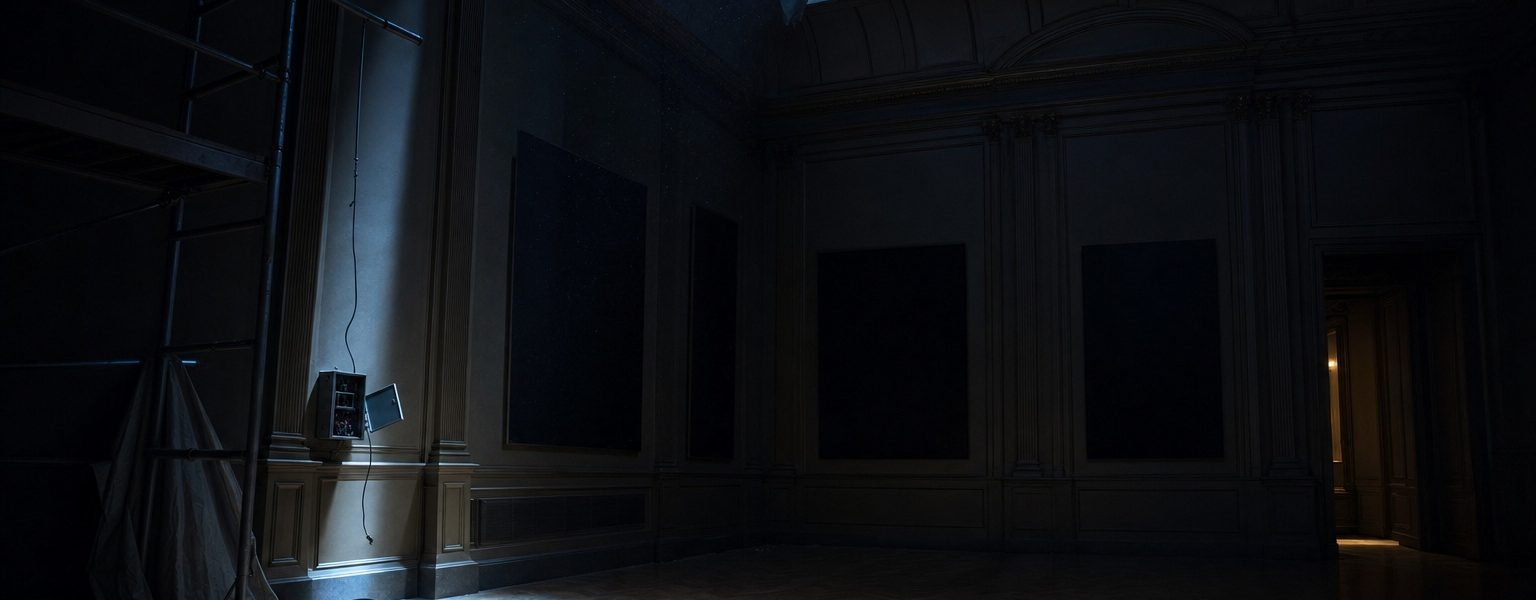
Shortly after midnight on 4 September 1972, a man with climbing spikes on his boots went up a tree beside the Montreal Museum of Fine Arts, lowered a ladder from the roof to two accomplices, and let them in through a skylight. The three men left with eighteen paintings — among them a Rembrandt landscape — and thirty-nine pieces of jewellery and figurines. It remains the most valuable theft in Canadian history, and it remains unsolved.
The detail that matters most is the least cinematic one. The skylight had an alarm. It had been switched off because the roof was under repair, and it stayed off. The thieves did not defeat the museum’s security; they walked through the one place where it had been suspended for convenience.
Fifty years later, a very different Canadian institution was told something remarkably similar about itself. In June 2022, the Cullen Commission delivered an 1,800-page report on money laundering in British Columbia, much of it concerned with the province’s gaming floors. Its central finding was not that criminals had outwitted the casinos. It was that the warnings had been arriving since 2008, the controls existed on paper, and nobody with the authority to act treated the exception as urgent.
The blind spot is never the vault
Museums and casinos are structurally the same kind of building. Both hold enormous concentrated value. Both are legally obliged to let the public walk in and stand next to it. Both spend heavily on cameras, guards and hardened perimeters, and both train their staff to watch the crowd.
And in both, the crowd is rarely where the loss happens. The failure sits in the seam — the moment when a normal routine is temporarily set aside and no one writes down when it should resume.
Renovation, transition, and the temporary exception
In 1972 the exception was a tarp over an alarmed skylight. In British Columbia, it was a tolerance for bulk cash that was supposed to be provisional and became the operating norm: by 2014, casinos were accepting well over a billion dollars in single transactions of $10,000 or more, many of them matching known indicators for criminal proceeds.
Museum security professionals have a phrase for this — the construction window. Loans, deinstallations, HVAC upgrades and renovations all require somebody to disable something. The risk is not the disabling. It is that the temporary exception has no expiry date attached to it.
The insider who is supposed to be there
The most famous art theft in history was carried out by a man the building had already cleared: the Mona Lisa walked out of the Louvre in 1911 under the coat of someone who had worked inside it. Museums are still slow to model this threat, because doing so means treating curators, contractors and night guards as a risk category.
Casinos reached the same conclusion late and reluctantly. Cash-handling staff, hosts and VIP managers sit at exactly the point where scrutiny is most costly to apply, because applying it slows down the customer who generates the most revenue. That is precisely the incentive Commissioner Cullen identified in his findings on the BC Lottery Corporation.
Documentation is the real security system
This is where the two worlds converge most exactly. The art world’s defence against theft is not the alarm; it is provenance — an unbroken written record of where an object has been and who owned it. The reclamations that followed Napoleon’s campaigns of art looting were argued from inventories and treaty schedules — settled on documents, long after the fact, and never on locks.
A casino’s source-of-funds file is provenance for money. It asks the same question in the same form: where did this come from, and can you show me? Cullen’s recommendations pushed in that direction, urging a source-of-funds threshold as low as C$3,000 and fully account-based play.
Both sectors resisted for the same reason. Documentation slows a transaction, and slowing a transaction annoys the person on the other side of the counter.
The migration online changes the geometry
Gambling has largely moved to environments where every wager is tied to a verified account, and Canadians now compare licensed real money Casinos in Canada rather than driving to a provincial floor with cash. Whatever else that shift has done, it has produced the audit trail the physical rooms never had. (Players should still treat gambling as entertainment and use the deposit and time limits regulated operators are required to offer.)
Museums are attempting their own version through digitised catalogues and object-level records. The lesson from the Skylight Caper is that neither sector loses to spectacular attacks. Both lose in the quiet interval when a control was suspended for a good reason and nobody scheduled its return.